Alaska presents unique challenges when it comes to building. Severe winter conditions, freeze-thaw cycles, permafrost, and remote areas increase the construction and operational costs of a building for a lifetime. J&B Construction, a contractor providing home construction services in Alaska, is focused on building value for our customers.
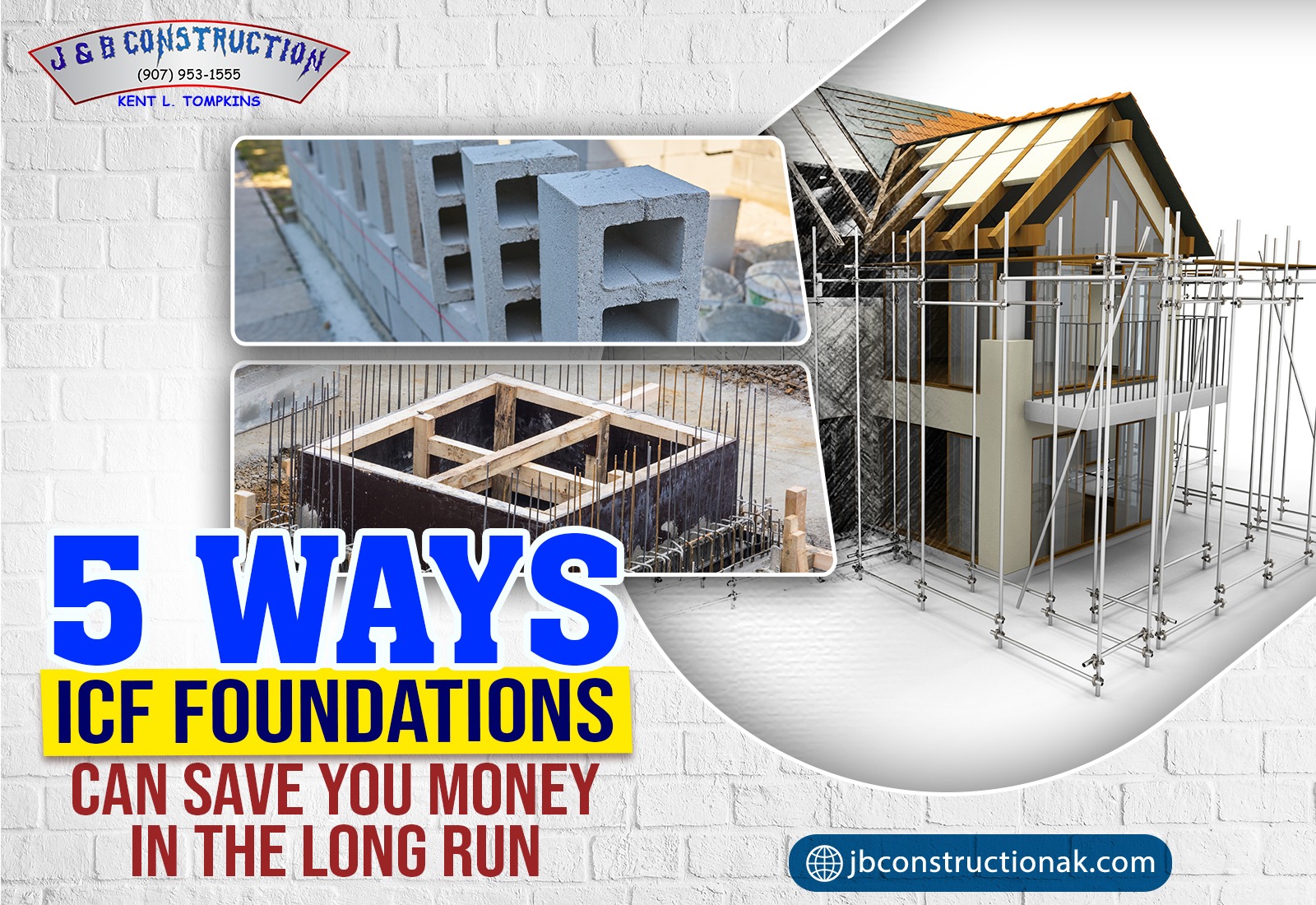
One of the most value-added construction techniques is the use of Insulated Concrete Form (ICF) foundations. Integrated with steel buildings or any other traditional construction, ICF foundations provide savings not just in construction but in the long-term operational costs for the entire lifetime of the structure as well.
These are five reasons ICF foundations make sense financially for Alaska construction, especially Steel Building Construction Alaska projects.
5 Smart Ways ICF Foundations Cut Your Long-Term Building Costs
Building in Alaska means facing extreme temperatures and challenging terrain. By choosing insulated concrete form (ICF) foundations, homeowners and businesses can save significantly on heating, repairs, and maintenance over time. As an experienced contractor, J&B Construction combines ICF with steel buildings to create strong, energy-efficient structures.
1. Energy Efficiency: Lower Heating, Cooling, and Utility Costs
The cost of heating any Alaskan building is considerable, and the extreme cold means a lot of heat loss through the walls and the foundation.
Infinite insulation & thermal mass:-
ICF walls have insulation (foam layers) and a reinforced concrete core. The walls keep the middle of the building implementing (or forcing) thermal mass. Studies have shown that ICF buildings, on average, consume less energy. An ICF building with less thermal bridging helps hold the heat and cool air (when needed) from escaping. The overall heating and cooling demands of the building are much lower.
Due to the ICF walls’ ability to maintain the internal temperature of a building, the heating and cooling systems of the building can be smaller, less aggressively run, and less expensive (in the long term) to operate and maintain.
Less drafts, fewer cold spots:-
The ICF building envelope guarantees the warm air stays in the building and less of it escapes. During warm winters in Alaska, mitigating drafts means substantial heating (loss) of waste. ICF can substantially reduce heating costs, especially with appropriate sealing and insulation.
When it comes to steel buildings, particularly those with more conductive metal framing, the ICF foundation performs a valuable role. It prevents heat from escaping the ground and stabilizes the base temperature to improve energy performance.
2. Reduced Maintenance and Repair Costs Over Time
While ICF foundations cost slightly more than basic concrete or wood-frame options, the long-term savings from the reduced maintenance usually more than compensate for the difference.
ICF construction is highly damage-resistant. For Alaskan homes exposed to moisture, snow, and freeze-thaw cycles, the rot, mold, pest, and moisture damage resistance results in fewer repairs and maintenance.
The strength of the concrete core with rebar makes it superior to many traditional foundations. For Steel Building Construction Alaska scenarios where foundations must support heavy, concentrated loads and resist movement, this strength translates to cost savings, avoiding foundation repair or reinforcement.
The longer ICF foundations retain their structural integrity, the longer homeowners avoid costly retrofits and premature replacement. In the long run, this could mean ICF foundations save their owners the most money over several decades.
As a contractor with a lot of experience in home construction services in Alaska, J&B Construction knows that choosing a foundation system that is decay and damage-resistant will mean fewer callbacks, less exposure to weather damage, and lower long-term costs.
3. Faster Construction Timeline = Lower Labor Costs & Earlier Returns
In construction, time really is money. In Alaska, time is money. Opportunities to work are constrained, permits can delay or add costs, and logistics can be costly. Building quickly is an advantage.
More quickly built and installed foundation forms:
Compared to some classical forms, ICF kits are easier to assemble and require less time and labor. ICF integration combines several construction steps and saves labor time because you have insulation, a vapor barrier, framing support, etc.
Weather-related delays are less severe:
ICF foundations can be constructed in colder conditions more than some other construction methods, which places ICF construction less at the mercy of dry, thawed ground. This maintains on-schedule delays in foundation work, which is always the greatest influence on project continuity.
Earlier occupancy is possible:
ICF construction allows other structural parts to be enclosed sooner, so work can begin on the interiors earlier. This translates to an earlier occupancy, which is always an earlier ROI.
For integration with steel-framed buildings, the ICF foundation speed of completion directly translates to steel erection speed. An ICF foundation allows the contractor to quickly transition to the erection of the steel frames, which in turn helps eliminate time waste on costly frames and idle labor.
4. Lower Insurance, Operational & Long-Term Ownership Costs
A building incurs various costs throughout its life cycle. These costs include insurance, heating, energy, maintenance, depreciation, and potential resale costs. With ICF foundations, many of these costs can be minimized.
When it comes to insurance, ICF foundations can lead to lower insurance costs. This is because ICF foundations are less susceptible to fire and moisture damage. Additionally, they are resistant to mold, pests, building deterioration, and structural shifting risks. Insurance companies may consider these buildings lower-risk, resulting in lower rates and surcharges.
When it comes to the cost of ownership, of thermal energy, physical maintenance, and moisture control, ICF foundations provide sustained lower ongoing costs. In Alaska, where heating and moisture control costs are expensive, the cost-saving potential of ICF foundations in the regime of insulation and moisture resistance is significant.
Properties and buildings that have a history of energy efficiency and maintained ICF construction are highly desirable in the market. This is due to the reduced operational costs associated with utilities, structural integrity, and reduced maintenance that a buyer faces post-acquisition of the property.
Building with ICF can be a selling point for someone seeking reliable home construction services in Alaska or looking for steel building construction services in Alaska.
5. Adaptability, Sustainability & Long-Term Regulatory and Climate Resilience
Alaskan statewide climate, general building codes, energy codes, and societal expectations are becoming more adaptive, and still, ICF foundations are designed to accommodate any building code changes.
Altitude ICF foundations, margins of safety in extreme, climate-controlled, and unregulated environments are noteworthy. Harsh weather conditions will be less likely to compromise the structural safety of ICF foundations. Moisture infiltration, frost heaves, and empty-permafrost spaces will not be deep freeze-thaw cycles, and frost heaves.
Flexibility in building design and expansion: The building code states that progressive building design must support planned future changes, and the foundation must be designed to support planned future increases. The construction of ICF systems allows ICF to maintain both.
Ecological costs are less: When constructing ICF systems and other building materials, ICFs require less energy, waste, and waste, provide more of the other, use more sustainable and recycled construction materials, and ICF waste can be reclaimed after ICF construction. Dissipate and minimize energy costs more with ICF instead of traditional construction systems.
Considerations & When ICF May Not Be the Right Fit
Though ICF foundations tend to be a worthwhile investment, they cannot be regarded as the most suitable option in every case. A reliable contractor will help assess whether ICF is a good fit for your project in Alaska. Here are some important considerations:
Initial Investment: ICF blocks, foam insulation, rebar, and skilled labor are initially more expensive than simple concrete or wood foundations. If bottom-line budgets are a significant concern and you plan on a short stay or a quick sale, the expected payback period can extend considerably.
Complexity of Design: Unusual or complex designs and steel erections that require special attention to anchors will need a little more effort on the planner’s side. In the case of steel structures, special attention to load bearing and anchoring may require the foundation to be modified or reinforced in a way that resolves the balance and counterbalance issues of the structure and foundational steel.
Remote Location: Isolated or difficult terrain, or areas where the transport of large ICF blocks is expensive, may offset some of the cost benefits. Costs related to transport, freight, fuel, and handling tend to be more expensive in Alaska, especially in remote areas.
Contractor Expertise: ICF installation is an area of specialty, and poor installation can defeat many of the purpose benefits, such as insulation or moisture control. Getting the right contractor who knows ICF well and understands the local dynamics is critical.
How J&B Construction Helps Maximize the Savings?
J&B Construction takes pleasure in the value ICF foundations offer to our clients. We approach our clients with the following strategies to ensure client value translates into cash value.
1. Evaluation and design
Careful attention is paid to the evaluation and design of soil, permafrost situational risks, drainage, environmental conditions, and frost depths. We design foundations for all the above considerations for both standard homes and even steel buildings.
2. Quality construction materials and practices
In all our construction works, ICF forms, foam insulations, reinforcing steels, and Alaskan weather concrete mixes are used. Construction has properly detailed waterproofing, sealing, and insulation, all of which lie within construction best practices.
3. Construction and sequencing for efficiency
In our work, construction, and installation of ICF systems, sequencing is employed to minimize wasted time, thereby reducing delays, optimizing labor, and lowering costs. We are able to reduce heating costs that are incurred after construction by early enclosure, insulated enclosures, and controlling moisture.
4. Energy performance focus
Utility bills are a concern for all clients, and therefore, all clients appreciate our efforts in designing foundations that work with walls, roof, and steel framing, or even windows and steel frames. For steel buildings, we adjust the performance of the foundation to ensure it supports the efficiency of the overall building envelope.
5. Low maintenance design
Revised building systems that contain fewer amenities for pests, moisture, and settling are a relief to clients and a value to the company. They leave the clients with less maintenance, fewer repair calls, and, thus, overall lower maint. costs.
Frequently Asked Questions
1. What distinguishes ICF foundations from traditional foundations?
With ICF (Insulated Concrete Form) foundations, insulated foam blocks are incorporated with reinforced concrete. This provides immense energy efficiency, moisture resistance, and strength. This also means greater value when compared to traditional concrete foundations and wood foundations. For the Alaskan market, this also means lower long-term heating and maintenance costs, as the harsh climate will increase the costs significantly.
2. In what ways do ICF foundations reduce energy costs?
The insulation built into ICF foundations helps maintain an indoor temperature all year long. This significantly reduced the need to constantly heat the space during the winter, and, to a lesser extent, to cool the space during the summer. This characteristic makes ICF the best choice for Home construction services in Alaska.
3. Is there compatibility between ICF foundations and steel buildings?
Definitely, ICF foundations are designed for and work extremely well with steel buildings. This combination builds up the structural stability and improves energy efficiency of the overall structure, in addition to increasing the longevity of the building as well. This is why many of the Steel Building Construction Alaska projects are using ICF foundations.
4. Is maintenance of ICF foundations a complex task?
Absolutely not. This is where ICF systems shine in their value proposition. Because the system is not moisture susceptible and not shifting, pests are not an issue for the system, and therefore the system will not suffer from moisture rot, and will not need to suffer from shifts in the structure. This is a huge value to homeowners and business owners.
Conclusion
If you’re planning to build in Alaska — whether a custom home, a commercial structure, or a steel building— investing in an ICF foundation may cost more upfront, but the savings over time are real, measurable, and significant:
– Lower energy bills
– Reduced maintenance and repair costs
– Faster project timelines and earlier returns
– Lower insurance and operational costs
– Improved resale value and long-term resilience
As a skilled contractor in Alaska specializing in home construction services in Alaska and Steel Building Construction Alaska, J&B Construction is here to help customers evaluate when and how ICF is the right choice—and to execute it correctly. Choosing the right foundation isn’t just about what you spend today. It’s about what you save over the life of your building.