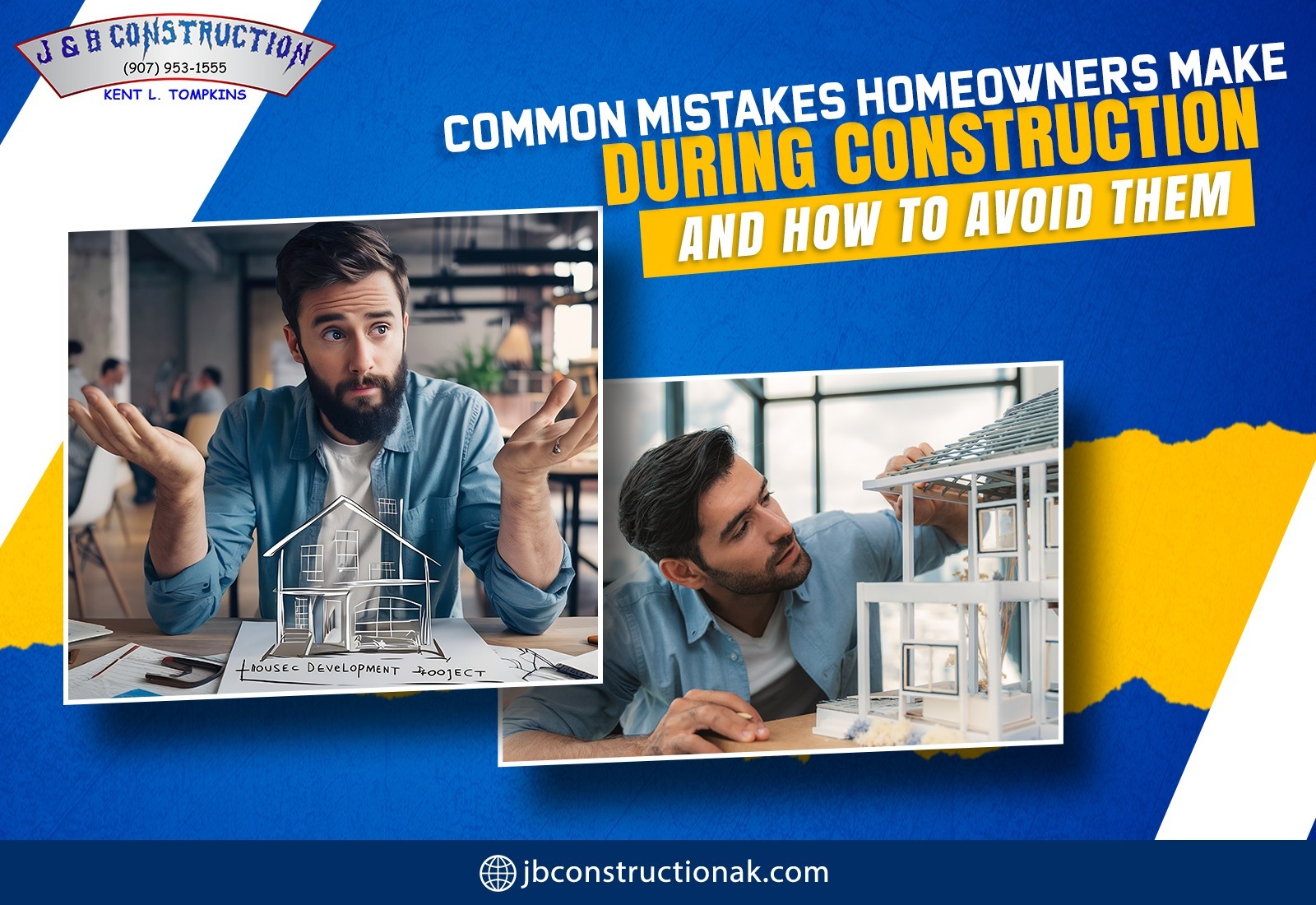
Constructing a residential or commercial structure in Alaska entails a profound adventure. It entails making prudent choices, detailed planning, and executing the plan perfectly. Having a skilled contractor who knows the local climate, landscape, and building regulations is necessary.
Don’t worry, we’ll be sure to save you the headaches if we get you a traditional home or a steel construction. J&B Construction is a home construction service in Alaska and Steel Building Construction Alaska. Having worked with a contractor, we understand the mistakes that most clients make and how we best prevent them.
1. Planning and Design Phase
Mistakes:
Rushing their build after their plans have gone unchecked. Homeowners fail to assess the layout and materials needed for long-term and future expansion. Designs that aren’t catered to energy efficiency, structural strength, and the evil Alaskan climate.
Drawbacks:
- When windows are not properly insulated, it will lead to high heating bills.
- Draughty, inefficient room layouts, over-under appropriately sized room systems, lead to costly fixes.
- Changes to the design in construction will cause costly delays.
How to avoid it:
- Plan. Collaborate with your contractor to develop thorough plans.
- Take into account foundations, snow loads, exposure, wind, insulation, and orientation (e.g., sunlight, prevailing wind).
- For steel structures, make sure the design aligns with foundations, insulation, and sealing, and the designs should encompass loads, anchor systems, and the thermal bridge between steel and non-steel components.
- Think about future additions (e.g., extra rooms, garage, workshop). You want to avoid outgrowing your design.
2. Underestimating the Budget and Failing to Account for Hidden Costs
Mistake:
Homeowners get quotes for archetypal builds and exclude 20-30% of “extras” such as permits, inspections, delays, inflation of materials, site work, unexpected weather, and costs.
Why it hurts:
- More than 30% budget “extras” cause stress and may lead homeowners to less desirable budgetary decisions, such as poor quality materials, insufficient insulation, and incomplete finishes.
- In Alaska, remote and winter season delays can be costly if workers and equipment are also delayed and sit idle.
- Considerably expensive replacements, such as structural reinforcement, are often needed when proactive design could have avoided these costly fixes.
How to avoid it:
- Request your contractor to provide you with a complete and detailed line-item budget that considers land work, foundation, utilities, insulation, specialized features, and contingency funds.
- In-home construction services in Alaska, winter and frost periods, are significant construction season constraints. Forecast weather and site prep for remote equipment shipping.
- In Steel Building Construction in Alaska, you should also consider the costs of transporting steel, anchoring, insulation, flashing, and finishing, as well as the cost of the metal. While metal components are competitively priced, specialized labor, foundation work, and extreme weather work are considerable.
3. Ignoring Soil, Frost, and Foundation Conditions
Mistake
Assuming all land is the same or not taking the time to check soil, frost, or permafrost conditions. Or thinking a simple slab would work without analyzing the site for freeze-thaw cycles and soil that can shift.
Why it hurts
- When poorly designed or built foundations settle, shift, or crack, the structure is at risk. This is worse when permafrost is present. The thawing of permafrost causes movement that can be catastrophic.
- Moisture incursion is a danger to the foundations, interior finishes, and insulation of buildings. It challenges the integrity of the whole structure.
- Foundations of steel structures, and the steel structures themselves, must be supported precisely. Deficient or unstable foundations result in expensive problems of structural misalignment, unstable frames, and misplaced anchor bolts.
How to avoid it
- Soil tests are necessary before the design to check for frost depth, soil bearing capacity, and permafrost.
- Match the site conditions with the correct foundation type and appropriate strategies, such as deeper footings, pilings, frost-protected, or insulated foundations.
- For steel structures, design frost- and freeze-thaw-resistant anchor connections, structural steel pads, and steel pads so that integrated connections at designed connection points are secured to the structural system.
4. Poor Water Management and Drainage
Mistakes:
Not grading the site correctly and then neglecting gutters, downspouts, and foundation drainage systems, as well as ignoring runoff entirely. Water collecting near the foundation and behind the siding is a regular cause of trouble.
Why it hurts:
- The damage it does includes ice damming, water infiltration, mold, wood rot, and erosion of the foundation. The freeze/thaw cycles cause the water in the soil to expand and contract, which puts pressure on the foundation and on walls and slabs.
- For Steel Building Construction in Alaska, moisture near the steel elements will promote the corrosion of steel, deterioration of joints, and cause thermal bridging and loss of energy due to condensation.
How to avoid it:
- Make sure the slope around the house is at least several inches and drains away from the foundation over a distance of 10 feet.
- Solid gutters and downspouts should be constructed, and proper footings should be French drains.
- The quality waterproof or moisture-resistant materials that will be used around the foundation and the proper flashing for steel-to-concrete transitions will also be required.
5. Overlooking Insulation, Air Sealing, and Building Envelope
Mistake:
Using cheap insulated materials, leaving insulation gaps, inadequate air sealing, insufficient thermal breaks around seams, foundations, recesses, windows, and doors.
Why it hurts:
- Energy bills remain high because heating systems work harder when the cold reaches the building.
- Excessive moisture and condensation, and possible future rot and mold in the walls and ceilings.
- In steel buildings, large metal surfaces rapidly absorb and dissipate heat. Poorly insulated and sealed steel buildings become inefficient and uncomfortable.
How to avoid it:
- Work with the contractors and insulation specialists to pick insulation with appropriate R-values designed for Alaska’s climate.
- Use continuous insulation where possible. Air sealing in the critical areas defined in foundations, window and door frames, roofs, and joints.
- Make sure windows and doors are flashed, sealed, and installed correctly.
- Include insulation in the foundations to reduce ground heat loss, e.g., use ICF, insulated footings, and insulated slabs.
6. Hiring Unqualified or Low-Cost Contractors Without Vetting Them
Mistake:
Not checking a contractor’s credentials or history in obtaining a construction job. Not knowing what kind of construction the contractor has already done in the area.
Why it hurts:
- The contracted work may be done incorrectly or with insufficient material that employs the wrong techniques.
- Mistakes involving foundation misalignment, code/legislation contradictions, or risking safety may occur.
- A warranty, the resale value of the building, and future maintenance may suffer if the work is of low quality.
How to avoid it:
- Interviews can be done with a number of contractors to get a wider view on price. In the case of the construction of steel structures, ask about experience with steel buildings and Steel Building Construction Alaska.
- Make sure a contractor has a building and Alaska construction code insurance, and that the contractor should hold to the general compliance of the Alaska building codes. Contractors should be able to have guarantees or a range of work that has no hidden surprises.
7. Disregarding Local Building Codes, Permits, and Inspection Requirements
Mistake:
Skipping permits or some code components for cost reasons. Ignoring local Alaska building regulations dealing with frost protection, foundation anchoring, snow load, building envelope, seismic, or wind, if applicable.
Why it hurts:
- Fines, tearing out work, legal issues, and bringing it up to code.
- Structural issues later are a certainty if the inspections are bypassed.
- Resale value and insurance coverage, along with long-term safety, are at risk with non-compliant work.
How to avoid it:
- Contact the local building departments so you understand local code requirements.
- Have your contractor include all the necessary permits.
- Make sure important stages include inspections: foundation, framing, roofing, etc.
- For Steel Building Construction Alaska, confirm the plans, anchoring, steel framing, insulation, and structural load capacities meet or exceed local code requirements.
8. Ignoring Climate & Seasonal Constraints
Mistake:
Ignoring the seasonal characteristics of Alaska when scheduling construction phases (restraining winter, decreasing daylight, snow load). Constructing during harsh weather conditions, inadequately wrapping moisture-sensitive materials, and leaving unfinished framing exposed to the weather.
Why it hurts:
- Excess snow, moisture in construction materials (timber, steel), and frost will cause harm. Improper curing conditions will lead to lost construction quality.
- The worst part is the delays; they quickly snowball into budget overruns.
- Hidden damage (frost heave and moisture migration) can show up later. This leads to costly repairs.
How to avoid it:
- Plan to carry out exterior work, frost-resistant foundation pouring, and framing during favorable high construction seasons. Wrap weather-sensitive materials to provide temporary protection.
- During cold weather, use construction techniques and materials specific to cold weather construction (e.g., moisture-resistant foundations, snow-load steel detailing).
9. Poor Communication and Change Order Management
Mistake:
Homeowners or contractors are making decisions on the fly without documenting changes, miscommunication between the design, contractor, and subcontractors.
Why it hurts:
- Leads to mismatched expectations, unexpected costs, delays, and material waste.
- Change orders can escalate budgets if not controlled.
- Misalignment between what’s built and what was planned can cause structural or finish quality issues.
How to avoid it:
- Establish communication and documentation standards to automate updates and inform decisions.
- Use change orders to avoid scope creep and assess time and cost impacts before approval.
- Ensure the designer, architect, contractor, and subcontractors have the same current plans.
How J & B Construction Helps Homeowners Avoid These Mistakes?
At J&B Construction, we strive to provide the most dependable, long-lasting, and reasonably priced structures throughout Alaska. As a top contractor with extensive experience in Home construction services in Alaska and Steel Building Construction Alaska, here’s how we help to ensure your project avoids these mistakes:
Meticulous Pre-Construction Planning
Every project begins with comprehensive evaluations that include the site, testing for soil and permafrost, the design, and even energy models, and discussions around future needs.
Honest Budgeting & Defining Scope
We help you understand the cost, leave room for contingencies in the budget, and clarify the construction scope so you understand what is incorporated (foundation, structure, insulation, steel components, etc.).
Understanding the Integration of Foundations and Steel Buildings
We focus on both homes and steel structures, and we know how the design of the building foundation, steel framing, and the building envelope come together. We design around anchor bolts, load-bearing areas, insulation, and connections so that we eliminate any structural surprises.
Attention of Code Compliance & Inspection
We understand the building codes for Alaska, which include frost, snow load, and seismic, and we get all permits and arrange for inspections at all the key milestones.
Construction Scheduling with Respect to Season & Weather
We know how to protect building materials as we plan for project execution. We understand and respect the principles of forming and placing concrete
Season & Weather Aware Construction Scheduling
To make the best use of the time when the weather is expected to change for the better, we schedule work to avoid wasting time when materials will be spoiled. We do know how to place concrete when it is cold, how to protect steel from rusting, and how to avoid moisture damage.
Strong Communication & Change Management
Barely, the change in the lines of the plan and construction will be an anomaly. We communicate these things, document changes, and show how all the groups are interlaced to form a construction plan. You’ll know what is happening, when it is happening, and why it is happening.
Conclusion
How to avoid mistakes is avoidable includes a detailed plan, building a budget, and hiring a good contractor. A homeowner saves time, and a contractor saves peace of mind, by avoiding mistakes in design, planning, escalation, code compliance, and estimating budget.
For anyone interested in the construction of Steel Buildings in Alaska, the steel construction systems, or other general home construction services in Alaska, the right choices from the beginning make all the difference.
Planning or building in Alaska is are big endeavor. If you’re ready to design, we would be happy to partner with you at J&B Construction. With our regional know-how, we will protect you from the common mistakes that are the most costly, by building strong and smart, over our years of regional expertise.